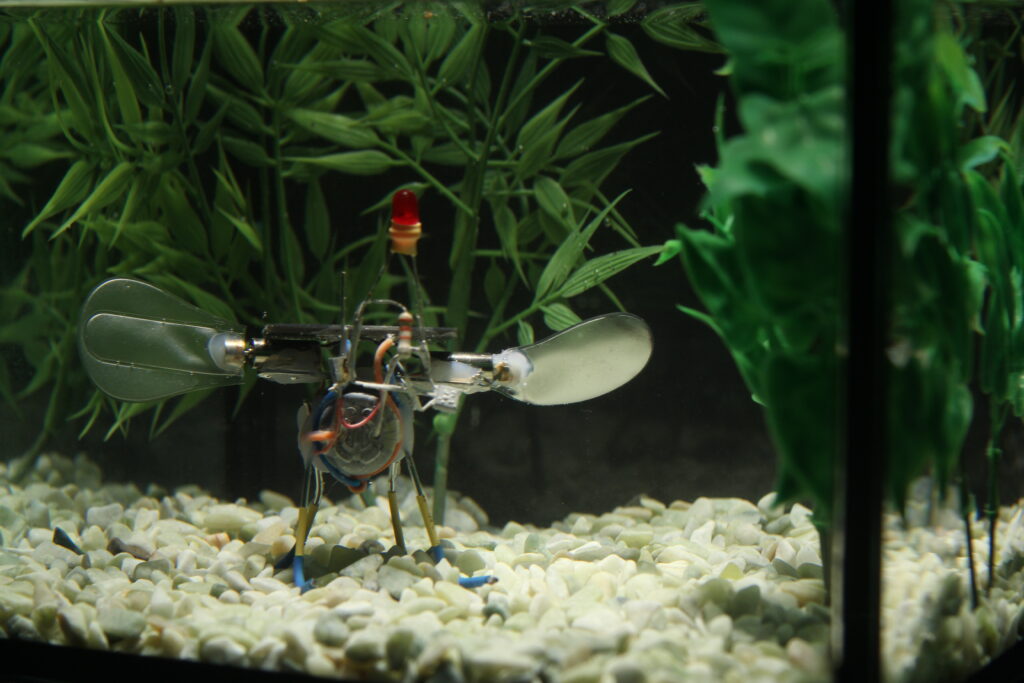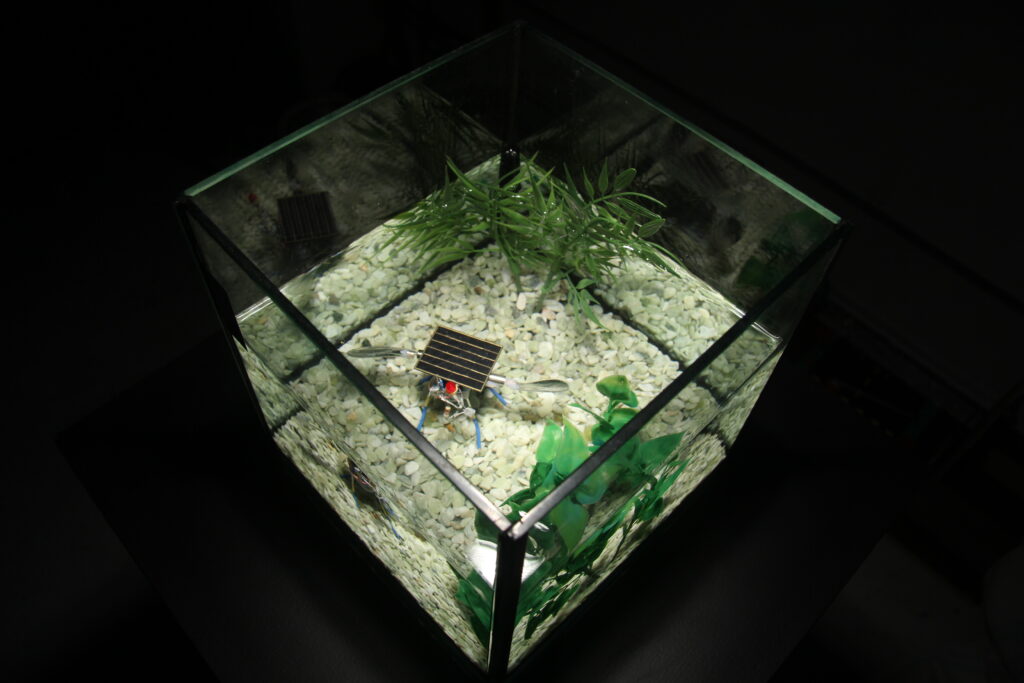
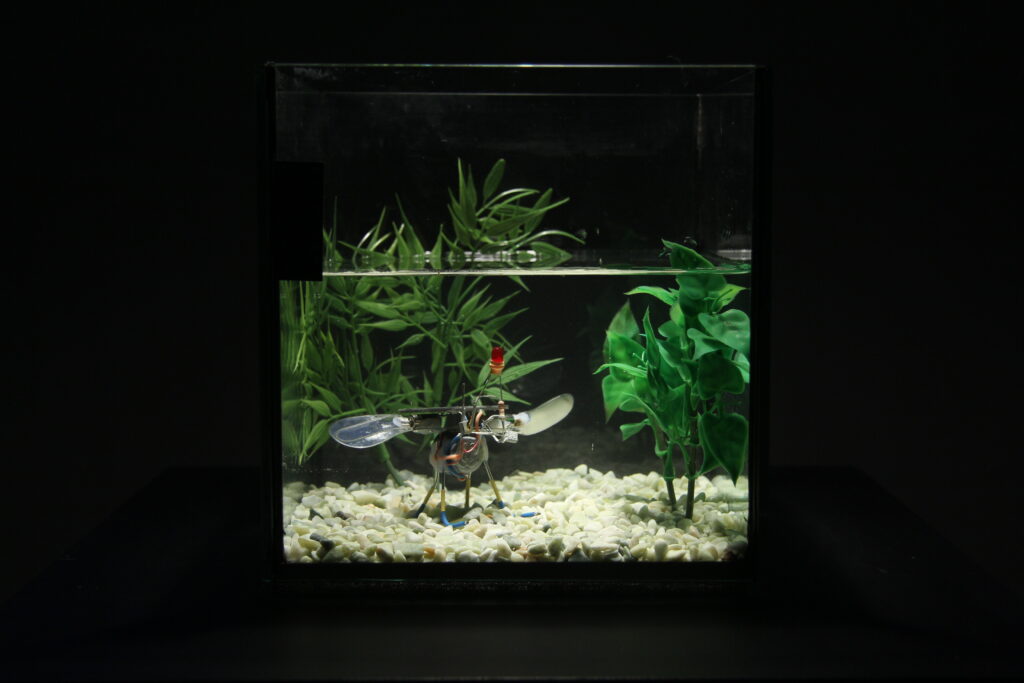
[FR] Propriété (2022) aborde les enjeux entourant la santé des lacs au Québec et les algues bleu-vert en focalisant sur la relation économique entre les riverain.e.s et leur investissement territorial personnel, ainsi que la perception de la nature comme ressource à exploiter et ses contradictions avec la question environnementale. L’œuvre présente un être ambigu, à mi-chemin entre la machine et la créature aquatique, restreint dans un habitat artificiel. Son état de captivité combiné à son caractère hybride évoque la tension existant entre le désir humain de posséder un territoire, et les conflits provoqués avec les êtres y vivant déjà. La réduction de la zone habitable, la modification des berges, la dissociation s’accentuant entre les êtres humains et non-humains ne sont que quelques exemples de phénomènes qui affectent l’écosystème global des lacs. Ceux-ci répondent de toutes sortes de manières, incluant la production démesurée de cyanobactéries.
[EN] Propriété (2022) approaches issues surrounding lakes’ health in Quebec (Canada) and blue-green algae by focusing on the economical relationship between waterside residents and their personal territorial investment, as well as the perception of nature as exploitable resource and its contradictions with environmental protection goals. The work presents a hybrid being, existing somewhere between machine and aquatic critter, restricted to its artificial habitat. Its captive state combined with its hybrid characteristics evoke the tension between the human desire to own a territory, and the conflicts that it creates with the wildlife already living in the area. The liveable habitat reduction, the bank modification, the ever-growing dissociation between human and nonhuman beings are a few examples of phenomena affecting the lakes’ global ecosystems. Subsequently, they react in various ways, including by an overproduction of cyanobacteria.
Les choix esthétiques et fonctionnels de l’œuvre reflètent plusieurs concepts philosophiques ou scientifiques, dont la notion d’animal-machine théorisée par René Descartes au 17e siècle. Cette théorie met de l’avant l’idée de l’animal non-humain comme simple mécanisme (sans intelligence, ni sentience) et sert à justifier l’utilisation, l’exploitation et les abus envers celui-ci. Bien que ce concept puisse maintenant sembler farfelu et archaïque, il influence toujours notre conception du monde en y plaçant l’être humain au centre et en lui conférant un pouvoir supérieur aux autres espèces. Le comportement de l’entité électronique au sein l’œuvre rappelle également le phénomène de stéréotypie qui consiste en un mouvement répété et sans but, souvent observé chez les animaux sous-stimulés en captivité.
The work’s aesthetic and functional choices reflect several philosophical or scientific concepts, including René Descartes’ 17th century animal-machine thesis. This theory pushes forward the idea of nonhuman animals as simple mechanisms (without intelligence or sentience) and is used to justify exploitation and abuse against them. Even though this concept now seems silly and archaic, it still influences our worldview by placing humans at the center and giving us more power than to other species. The behaviour of the electronic entity in the work also evokes stereotypy, a useless repeated movement that has often been observed in under-stimulated captive animals.
Propriété a été créée dans le cadre d’une résidence avec Génération DaVinci et l’Université de Montréal pour le projet Dessine-moi un lac. Merci à l’équipe d’organisation, de recherche et aux riverain.e.s du lac Ste-Anne à St-Ubalde qui ont bien voulu discuter avec moi des enjeux concernant la santé des lacs au Québec.
Propriété was created during an art-science residency with Génération DaVinci and the University of Montréal for the project Dessine-moi un lac. Thank you to the organization and scientific teams, as well as the waterside residents of lac Ste-Anne in St-Ubalde, Qc for talking with me about environmental issues surrounding waterways in Québec.